
Kubik
See how big a cubic metre really is – drawn to scale next to a person, for water, firewood, gravel, sand, soil and concrete.
Opens at everydayapps.se/app/kubik/
Maturity
- Idea(completed)
- Prototype(completed)
- Alpha(completed)
- Beta(current stage)
- Promoted
About the project
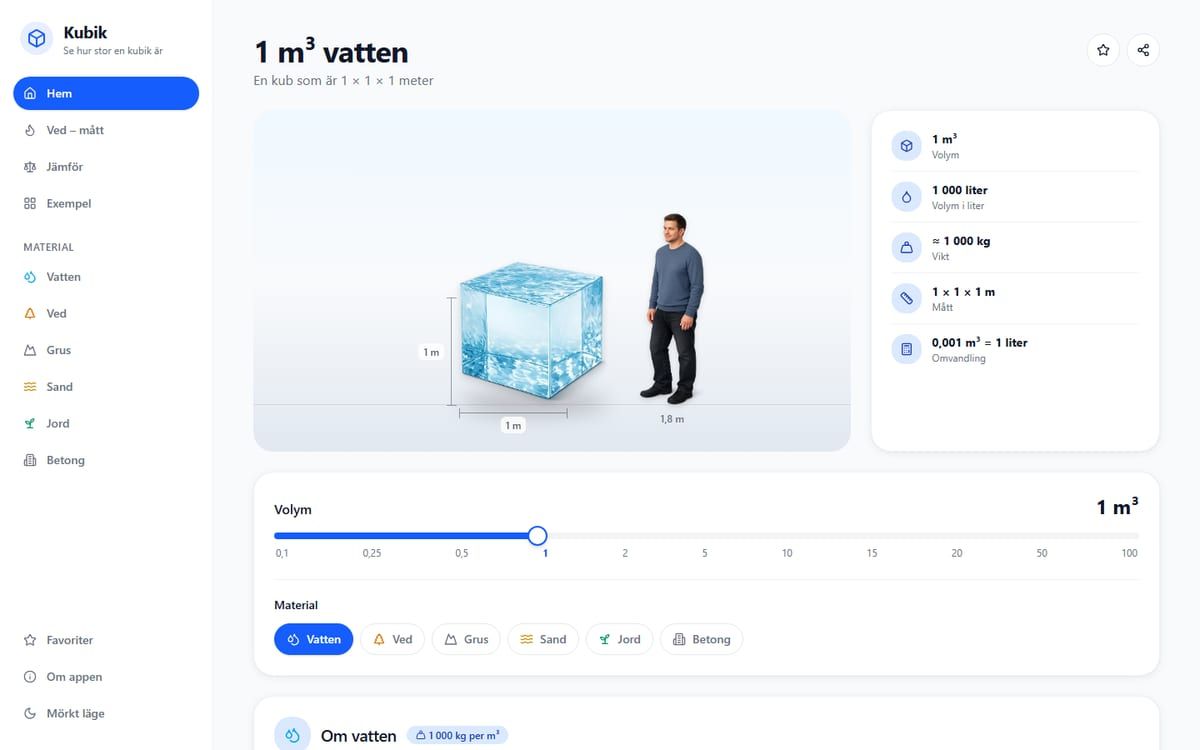
Kubik answers a question numbers are bad at: how big is a cubic metre, really? The cube is drawn next to a person, and as you drag the slider up towards ten or a hundred cubic metres, it grows at the same scale.
Firewood got a page of its own, because the difference between solid, stacked and loose cubic metres is what most often trips people up when buying wood – in Sweden, firewood is sold by all three. For measurements when you’re building, there is Tum till Millimeter (inches to millimetres) on EverydayApps.
Current state
What works
- The cube is drawn to scale next to a 1.8-metre person
- Six materials with their weight per cubic metre
- A slider from 0.1 to 100 m³ that redraws instantly, and a shareable link to every volume
- Firewood measures – solid, stacked and loose cubic metres and how they convert
- Comparison of two volumes, everyday examples, favourites and dark mode
What isn’t finished
- No automated tests
- Cubic metres only – no conversion between litres, cubic feet or other units of volume
- No calculator for how much material your own project needs
Why is this project on BSite?
- Features are not complete yet
Kubik makes volume easy to grasp, but it is more a visualisation than a tool you keep coming back to. On EverydayApps, Tum till Millimeter is the stronger measuring tool for anyone building things – with timber dimensions and carpentry terms. With a material calculator for your own projects, Kubik is a candidate to move back.
Screenshots
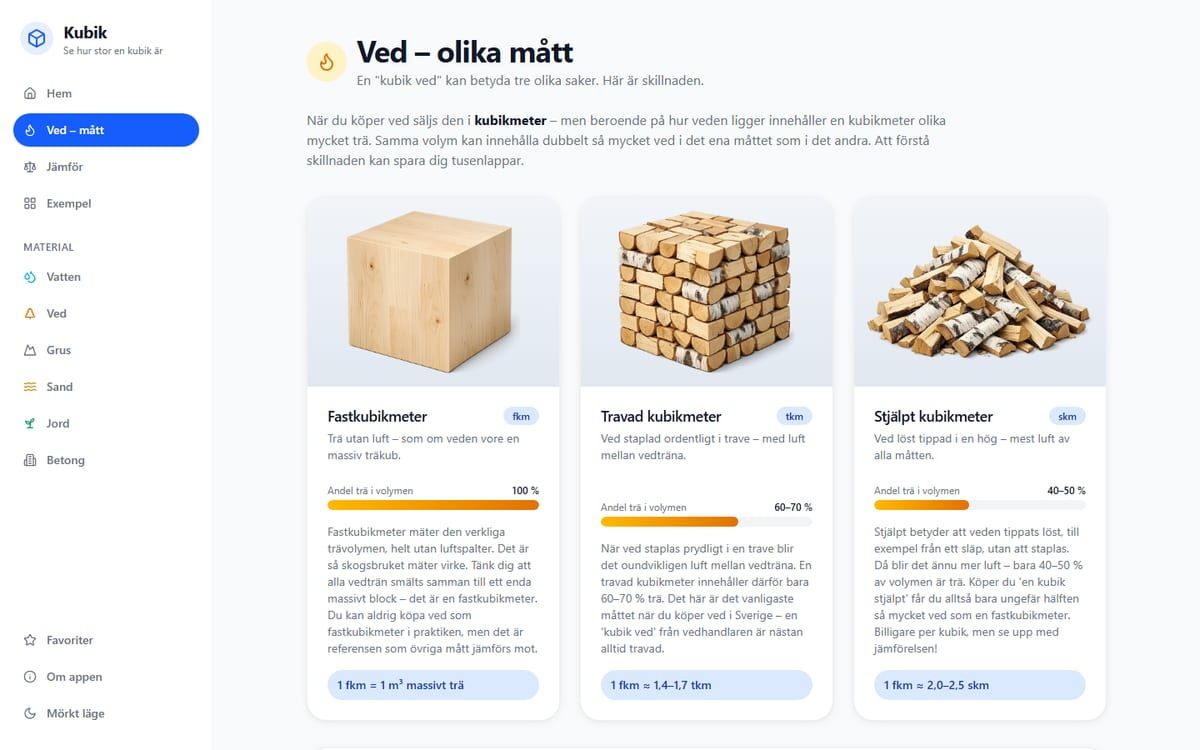
The firewood page explaining the difference between solid, stacked and loose cubic metres and how to convert between them. 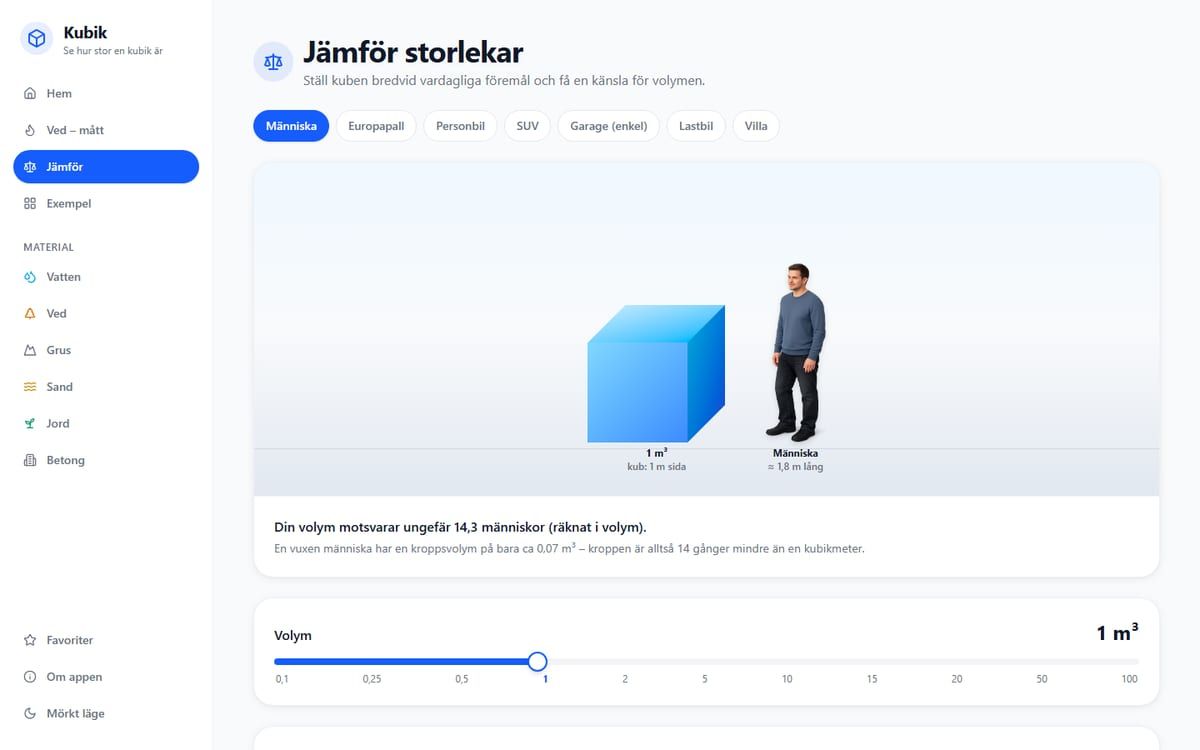
The comparison view, where two volumes are placed side by side to scale. 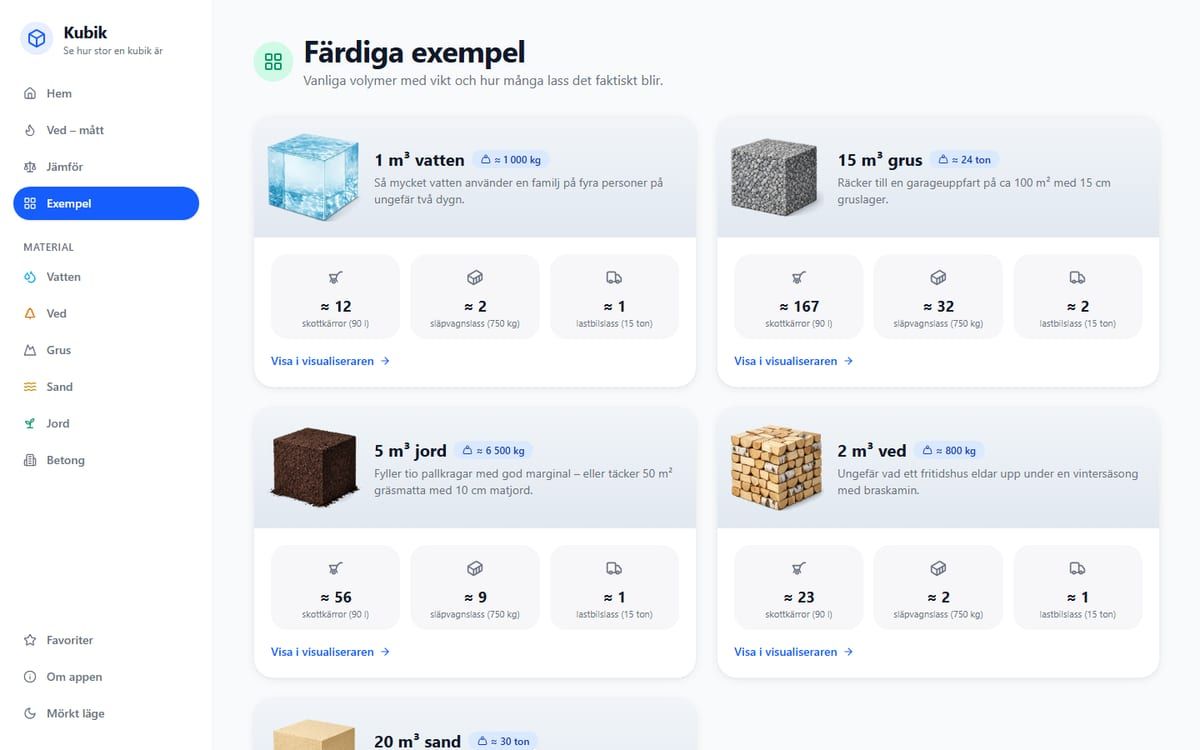
The examples page with everyday objects and how many cubic metres they correspond to.
Development log
Moved to BSite. The app stays at the same address, everydayapps.se/app/kubik/.
Got an install button in the app's own interface.
Built from a mockup, with custom generated images of the materials.