
Klockmästaren
A Swedish-language game where children aged 6–9 learn to read and set analogue and digital clocks in twelve living scenes, with spoken instructions and adaptive practice.
Opens at bsite.se/play/klockmastaren/
Maturity
- Idea(completed)
- Prototype(completed)
- Alpha(completed)
- Beta(current stage)
- Promoted
About the project
Klockmästaren is a clock-learning game for Swedish children aged six to nine. Every task happens in a small scene – a bedroom, a kitchen, a railway station, a town square – with one large clock in the middle that the child sets or reads. The clock faces, numbers, 60 tick marks and hands are always drawn by code, so the hour hand sits exactly halfway between seven and eight at half past seven.
The game is in Swedish on purpose. Swedish tells the time in its own way, counting minutes towards the half hour, and a 7-year-old learns those phrases, not a translation. Every minute of the day has its phrase in the grammar module, and the narrator reads the instructions, praise and hints aloud.
Practice adapts quietly: the game tracks first-try answers per skill, such as quarter past or the minutes before the half hour, and draws more questions where the child struggles. There are no penalties and no time limits in normal practice. A separate, optional speed challenge exists for children who already feel sure.
Current state
What works
- One clock engine drives every analogue design – the hour hand moves in proportion to the minutes, and dragging the minute hand past twelve steps the hour forward or back, never twelve hours at once
- Drag the hands with a finger or a mouse, use plus and minus buttons, or the keyboard; digital times by keypad, typing, arrows or dragging digits
- Thirteen task types – set the clock from text or speech, read a clock, match pairs, multiple choice, before and after, elapsed time, everyday situations, time of day and fix a wrong clock
- Correct Swedish time phrases for every minute of the day, spoken by a custom narrator voice with 277 recorded clips; missing speech falls back to the browser voice and then to text
- Twelve environments with their own clock casing, sound and reward animation – the alarm clock rings, the train leaves, the cuckoo comes out – in day and night versions
- The scene never gives the answer away – lighting follows the time only when the task itself states the time of day
- Adaptive practice per skill, hints by error type, an explanation and step demo after three tries, and no penalties or stressful sounds
- Free play with fast-forward, results with progress per area, medals, diplomas, cosmetic collectibles, a parent area and several local profiles
- Installable and offline after the first visit, with no account and no data leaving the device
What isn’t finished
- No child has played it yet – the difficulty steps, the adaptive weights and the hint wording are tuned against tests and simulated answers
- The narration and sounds were generated and measured but never listened to in the game
- Times that are not on a five-minute step are spoken from two joined clips, which may sound less natural than the full phrases
- Swedish only; an English version would need its own time-phrase module and voice
Why is this project on BSite?
- Early prototype
Klockmästaren is complete in scope, but whether it actually teaches is something only children can show. It starts in the lab until a few real children have used the menu without help and the practice levels feel right. Then it is ready for EverydayGames.
Screenshots
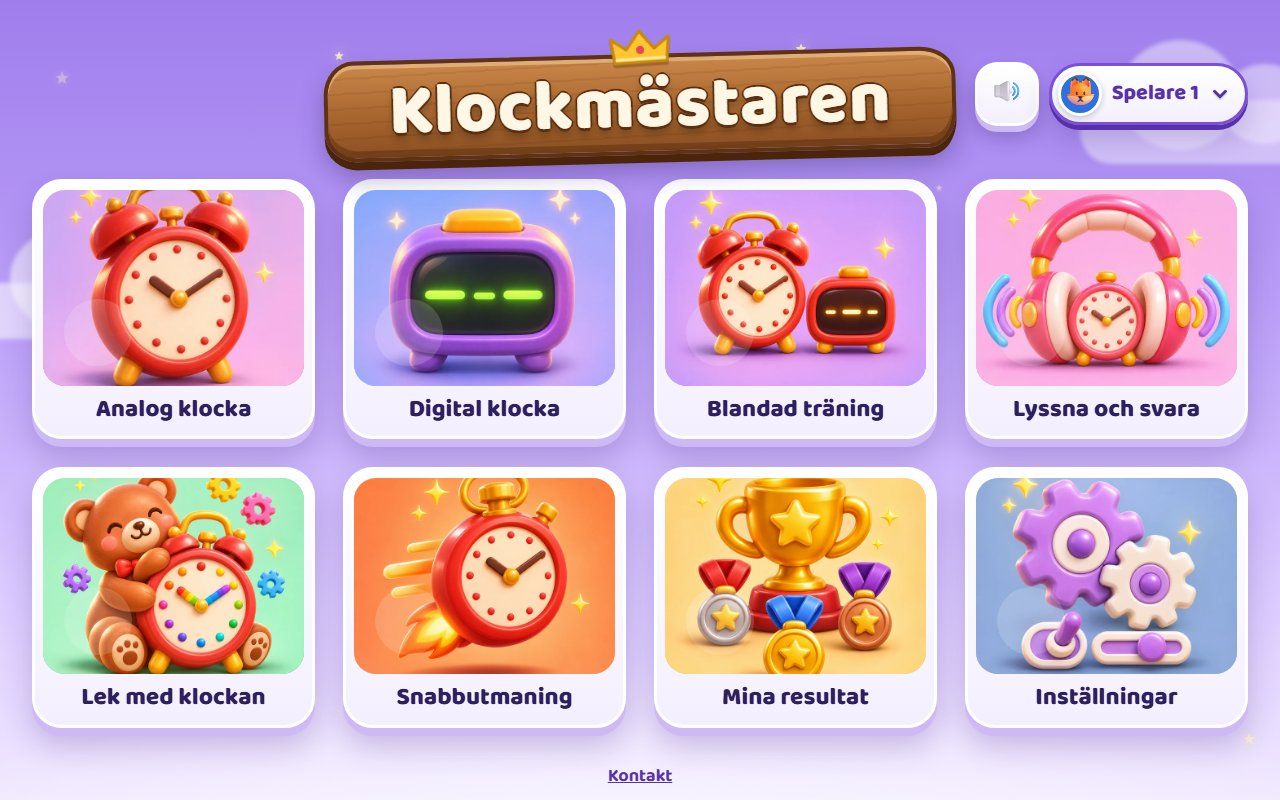
The start menu with the wooden-sign logo and eight illustrated cards – analogue, digital, mixed practice, listen and answer, free play, speed challenge, results and settings. 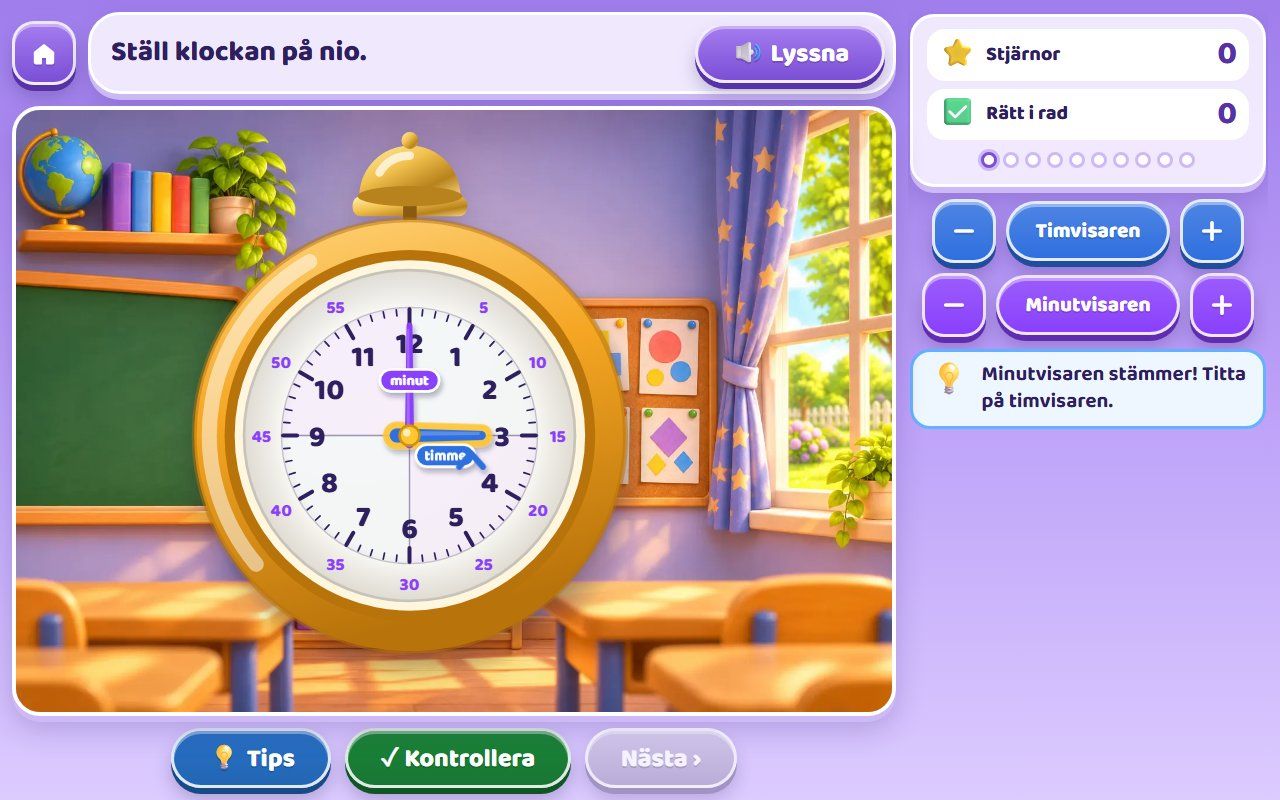
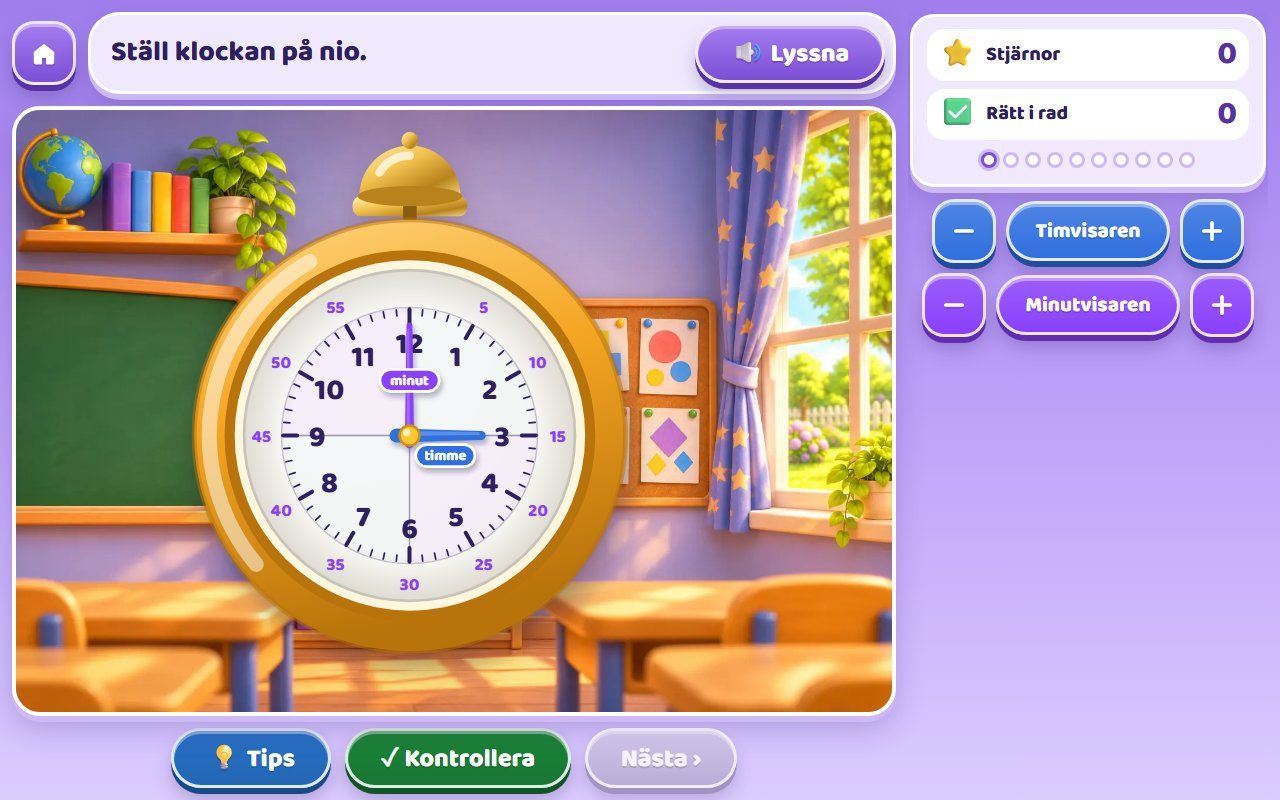
A wrong answer in the classroom – the child's setting stays on the clock, the hour hand is highlighted and a hint says the minute hand is right and the hour hand needs another look. 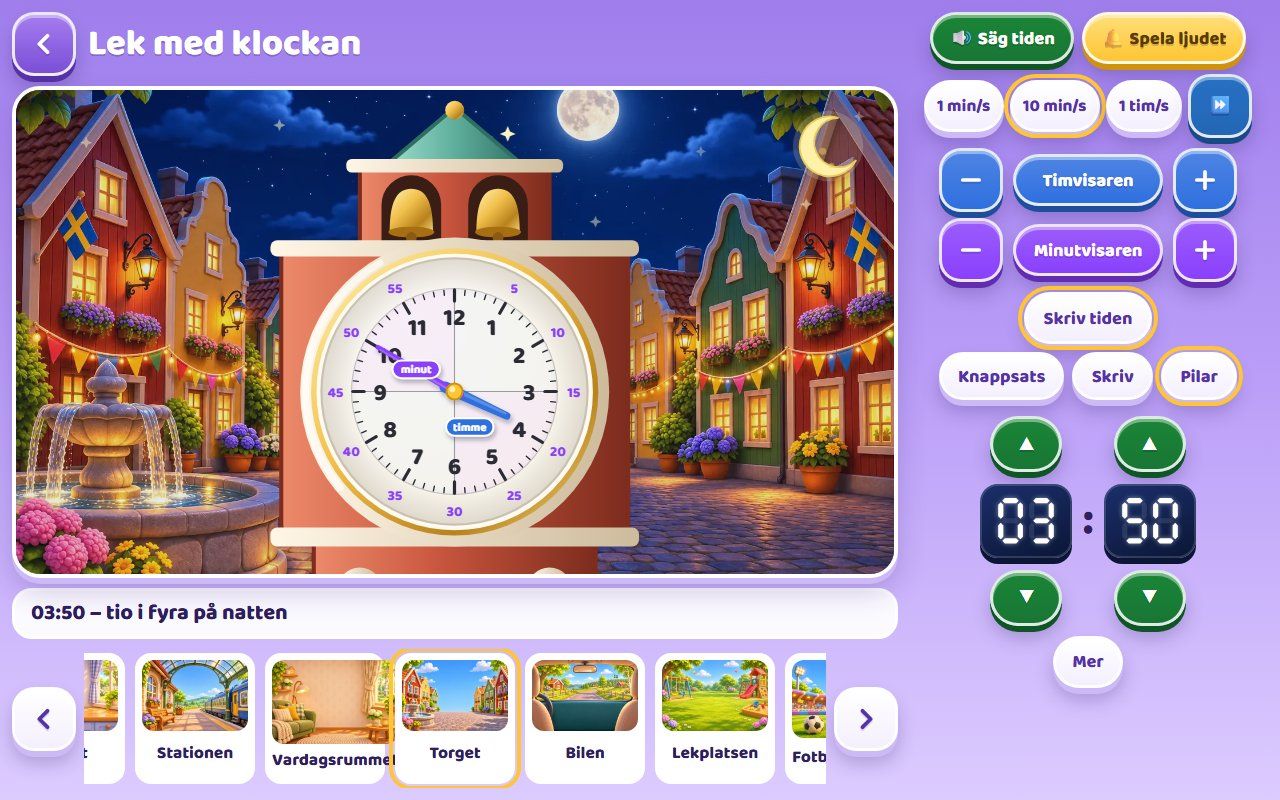
Free play at night on the town square – the clock tower under a moon, the matching digital time with up and down arrows, fast-forward speeds and a strip of twelve environments. 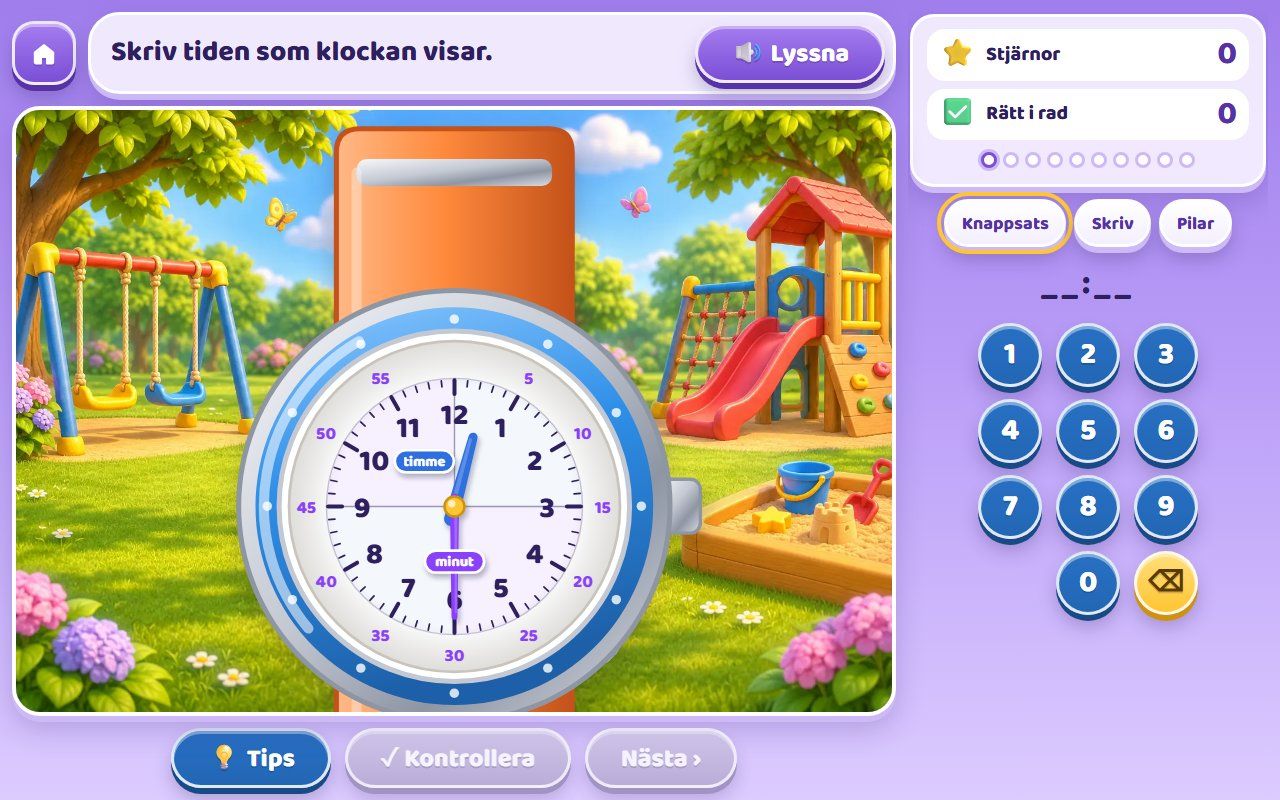
A digital-answer question at the playground – a big wristwatch and a microwave-style keypad for typing the time.
Development log
Version 1.0 – clock engine, Swedish time grammar, thirteen task types, twelve environments, narration, sound, adaptive practice, results and parent area built in one session and published in the lab.