
How temperature is measured
Height, shade, sensors and reading times: how SMHI measures air temperature, and which of its series Temperaturkollen uses.
Published
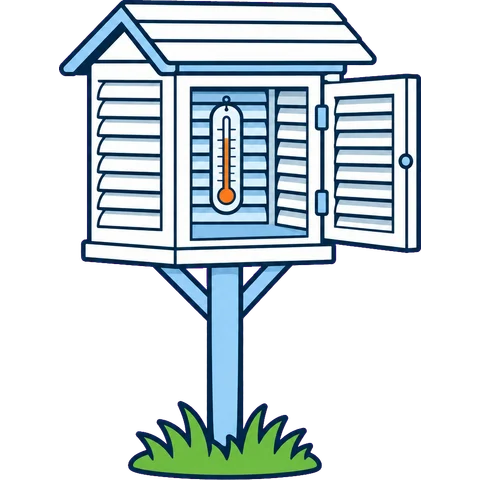
Every temperature on Temperaturkollen is a measurement from one of SMHI's weather stations. It is the temperature of the air at one point, measured in a standard way so that stations across Sweden can be compared. This guide follows SMHI's own description of how air temperature is measured.
Height, shade and open ground
SMHI measures air temperature 1.5–2 metres above the ground, preferably over flat, open ground with short grass. The thermometer must be shaded from the sun and protected from precipitation, but the site itself should not lie in shade. SMHI recommends that the distance to the nearest house is at least the height of the house.
The World Meteorological Organization (WMO) is stricter for its best class of station: large objects should be at least 30 times their own height away, and heat sources and reflecting surfaces such as roofs and asphalt at least 100 metres away. Large bodies of water should also be at least 100 metres away, unless they are typical of the surroundings.
From mercury to electronic sensors
For most of the 1800s and 1900s, temperature was read from mercury and alcohol thermometers. From the later part of the 1800s they were kept in white wooden screens. When weather stations were automated in the mid-1990s, electronic sensors took over, and between 2002 and 2005 the remaining mercury and alcohol thermometers at manual stations were replaced for environmental reasons.
SMHI's sensors are Pt100 resistance thermometers: a platinum wire, usually set in a glass body, whose electrical resistance is 100 ohm at 0 °C and changes by about 0.39 ohm per degree. Modern sensors sit in fairly small radiation shields. Some older types of shelter could, in extreme cases, read around five degrees too high, which is one reason why very old and new measurements are not always directly comparable.
How often a station measures
- SMHI's own automatic stations now report every minute. The value is the average of the sensor signal over the last minute.
- Other automatic stations report every hour, with averaging times from 4 seconds to 10 minutes depending on the station type.
- Manual stations are usually read at most two or three times a day: at 07, 19 and sometimes 13 Swedish standard time.
How accurate is it?
According to SMHI, thermometers rarely show errors of more than a few tenths of a degree, although the error can exceed a degree when the temperature changes quickly. Sensors are checked in melting ice, where they should read 0.0 °C.
What Temperaturkollen uses
We use four of SMHI's published series: the latest hourly value (shown as "right now"), the daily mean, the daily minimum and the daily maximum. The daily mean covers the calendar day 00–24 UTC, while the daily minimum and maximum come from a window from 18 to 18 UTC that ends on the day they are filed under. The guide on daily mean temperature explains why that matters.
According to SMHI, the oldest known temperature measurements in Sweden were made in Uppsala in 1722. The series on this site begin where each station's record in SMHI's open data begins.
Sources
All calculation rules in one place: about the data